

Table of contents
- What does it really mean for a child to be ready for JSS 1?
- How can you tell if your child is settling into JSS 1 nicely?
- What academic skills should a JSS 1 learner already have?
- Is my child becoming independent enough for JSS 1?
- How can parents assess emotional readiness?
- What social skills matter in JSS 1?
- How important is digital competence for JSS 1?
- What does a secondary school readiness assessment look like at home?
- What should parents do if their child is struggling?
- How does a values-driven school support the JSS 1 transition?
- What should parents ask a school about JSS 1?
- Conclusion: What should parents remember about JSS 1 readiness?
The transition from Primary 6 to JSS 1 is not complete when a child gets a new uniform, buys textbooks or passes Common Entrance. The real transition happens as the learner begins adapting to new academic demands, routines, relationships and responsibilities.
For families in Plateau State, the beginning of the 2026/27 academic session has also come with a brief interruption. Following a temporary closure of schools from September 7 as part of precautionary measures relating to suspected diphtheria cases, the Plateau State Government directed public and private primary and secondary schools to resume on September 14.
Now that school activities have resumed, an important question for parents is not simply “Is my child in school?” but “Is my child settling into JSS 1 well?”
What does it really mean for a child to be ready for JSS 1?
A child is ready to thrive in JSS 1 when they can manage age-appropriate academic work, follow routines with growing independence, communicate their needs, relate responsibly with others and respond constructively to challenges. Readiness is not a single test result. It is a combination of academic foundations, emotional maturity, social skills, independence and responsible use of technology.
The Nigerian Educational Research and Development Council (NERDC) curriculum already reflects the broader nature of basic education, with JSS learners engaging across areas including English, Mathematics, Basic Science and Technology, Social Studies, Civic Education, Business Studies, Information Technology and other subjects. That means the transition requires more than preparation for one entrance examination.
How can you tell if your child is settling into JSS 1 nicely?
The first few weeks can reveal things that an entrance examination cannot. A learner may perform well academically but struggle to organise school materials, ask for help, manage friendships or respond to correction. Another may need additional academic support but demonstrate excellent independence and resilience.
Parents can therefore look for patterns rather than isolated incidents. Ask yourself:
- Does my child understand what is expected of them each day?
- Can they explain what they are learning?
- Do they know how to ask a teacher for help?
- Can they keep track of books, assignments and personal belongings?
- Are they becoming more comfortable with the new school environment?
- Can they talk about difficulties without immediately giving up?
- Are they forming healthy relationships with peers?
- Can they accept correction without seeing it as rejection?
These questions provide a more useful picture of secondary school readiness than a single examination score.
What academic skills should a JSS 1 learner already have?
A strong academic foundation gives a learner room to concentrate on the new demands of secondary school. At this stage, parents should pay particular attention to reading comprehension, written communication, basic mathematics, following instructions and the ability to study without constant supervision.
NERDC’s curriculum structure confirms the central place of English Studies, Mathematics and Basic Science and Technology within basic education, while JSS 1 also introduces learners to a wider range of subject areas.
Instead of asking only, “What score did my child get?”, ask: “Can my child understand, apply and explain what they are learning?” A learner who can identify where they are confused and seek help is developing an important learning skill.
Is my child becoming independent enough for JSS 1?
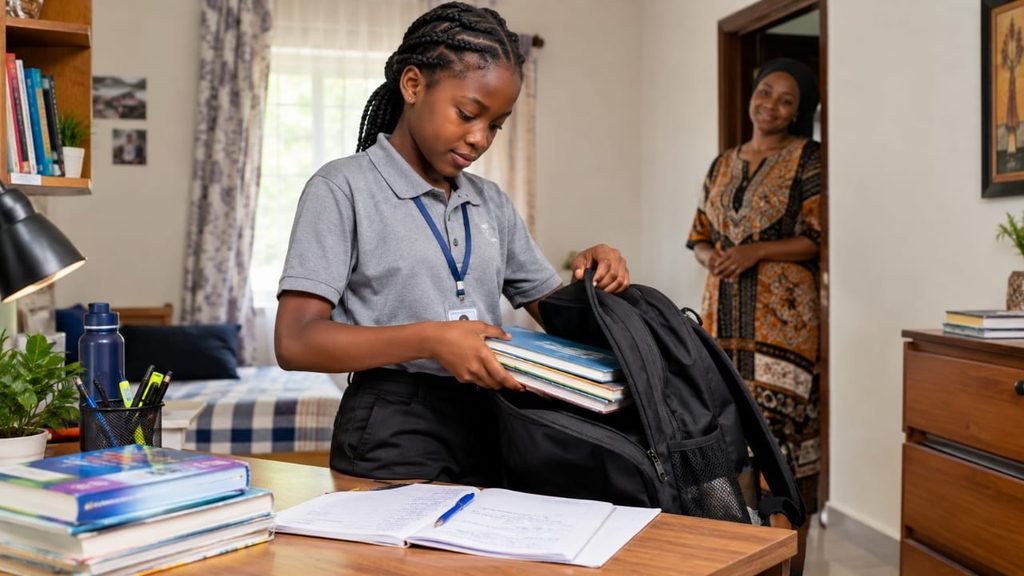
JSS 1 usually brings more responsibility. Learners may have more teachers, more subjects, different classrooms, multiple assignments and greater expectations around personal organisation. Parents should gradually move from doing tasks for the child to helping the child learn how to manage them.
Readiness Areas and Practical Tests
| Readiness Area | What to Look For | Parent’s Practical Test |
| Communication | Expresses needs clearly | Ask them to explain a problem without solving it for them |
| Cooperation | Works with others | Give them a small shared household task |
| Conflict management | Can disagree without aggression | Discuss a recent disagreement and ask what could have been done differently |
| Responsibility | Accepts consequences | Let them correct a manageable mistake |
| Boundaries | Understands appropriate behaviour | Discuss personal boundaries and respectful conduct |
| Help-seeking | Knows when to involve an adult | Ask who they would approach if they felt unsafe or confused at school |
The goal is not to expect adult-level independence from a child. The goal is to build age-appropriate responsibility.
https://patrisschools.org/full-boarding-half-boarding-or-day-school-choosing-the-right-option-for-your-teen-in-jos/: Settling into JSS 1: A Parent’s Guide to Knowing What Your Child NeedsHow can parents assess emotional readiness?
A learner does not need to be confident every day to be emotionally ready for secondary school. They need to develop healthy ways of responding when things do not go as expected.
Look for whether your child can:
- recover after making a mistake;
- receive correction without completely shutting down;
- express frustration appropriately;
- cope with a disappointing result;
- talk about worries;
- ask for support when needed;
- adapt when routines change.
Parents should pay attention to sudden or persistent changes in behaviour, especially when a learner consistently appears withdrawn, distressed, unusually fearful or unwilling to attend school. These may warrant a conversation with the child, teacher or appropriate professional rather than simply being dismissed as “part of growing up.”
What social skills matter in JSS 1?
Secondary school introduces learners to new classmates, teachers, authority structures and social expectations.
A child does not need to be the most outgoing person in the class. What matters more is whether they can communicate respectfully, cooperate with others, manage disagreements and recognise appropriate boundaries.
Parents can practise these skills at home through ordinary situations.
For example, after a disagreement with a sibling, ask:
“What happened? What part could you have handled differently? What could you do next time?”
This turns everyday experiences into opportunities for reflection and Character Formation.
How important is digital competence for JSS 1?
Digital competence is increasingly part of learning, not simply an extracurricular skill.
Nigeria’s revised curriculum includes digital literacy within the basic education pathway, while Information Technology is among the subject areas available at JSS level.
Parents should therefore consider whether their child can use digital devices responsibly, follow basic online safety rules, distinguish appropriate from inappropriate content, protect personal information and use technology for learning rather than distraction alone.
The question is not simply: “Can my child use a phone?”
It is: “Can my child use technology purposefully and responsibly?”
What does a secondary school readiness assessment look like at home?

A useful assessment does not need to feel like another examination. Over one or two weeks, observe your child during normal routines and rate each area honestly.
Secondary School Readiness Assessment Rubric
| Readiness Area | 3 | 2 | 1 |
| Reads and understands age-appropriate material | ☐ | ☐ | ☐ |
| Handles basic mathematics confidently | ☐ | ☐ | ☐ |
| Follows multi-step instructions | ☐ | ☐ | ☐ |
| Completes simple tasks independently | ☐ | ☐ | ☐ |
| Organises school materials | ☐ | ☐ | ☐ |
| Responds constructively to correction | ☐ | ☐ | ☐ |
| Manages ordinary frustration | ☐ | ☐ | ☐ |
| Communicates problems appropriately | ☐ | ☐ | ☐ |
| Cooperates with peers | ☐ | ☐ | ☐ |
| Understands personal boundaries | ☐ | ☐ | ☐ |
| Uses digital tools responsibly | ☐ | ☐ | ☐ |
| Knows when and how to seek help | ☐ | ☐ | ☐ |
3 = Consistently | 2 = Sometimes | 1 = Needs significant support
Do not treat the score as a pass-or-fail examination. Its purpose is to identify areas where your child is confident and areas where additional support may be useful.
What should parents do if their child is struggling?
First, identify what the learner is struggling with.
Is it reading? Mathematics? Organisation? Friendship? Confidence? Understanding instructions? Getting used to a new routine?
Then work with the school rather than waiting for the difficulty to become a major academic or behavioural problem.
A simple conversation with the class teacher can reveal whether the same pattern is visible at school.
At home, keep support practical:
- establish a consistent study routine;
- create a quiet place for homework;
- review schoolwork without doing it for the child;
- encourage reading beyond prescribed textbooks;
- help the learner organise materials;
- celebrate improvement, not only high scores;
- give them manageable responsibilities.
The objective is gradual growth in self-directed learning.
How does a values-driven school support the JSS 1 transition?
A good transition is not only about helping a learner cope with a new timetable. It is also about helping them understand who they are becoming.
This is where Character Formation, Leadership Education and holistic learning matter.
At Patris Schools, the idea of Building Nation Builders connects academic development with responsibility, character and leadership. The learner is not treated simply as someone who needs to pass examinations, but as someone developing the habits and values required to contribute meaningfully to family, community and society.
A strong school environment should therefore ask two questions together:
What is the learner learning?
and
What kind of person is the learner becoming?
Visit us to see for yourself. Check patrisschools.org for more details.
What should parents ask a school about JSS 1?
Before choosing or evaluating a secondary school, parents should look beyond facilities and examination results.
Ask:
- How does the school support learners during the transition into JSS 1?
- How are academic gaps identified and addressed?
- How does the school approach Character Formation?
- How are learners taught to become responsible and independent?
- How does the school handle bullying, conflict and safeguarding?
- What support is available when a learner struggles emotionally or academically?
- How is digital learning integrated responsibly?
- How does the school develop leadership skills?
- How do teachers communicate concerns with parents?
- How does the school measure progress beyond examination scores?
The answers can tell parents a great deal about the school’s educational philosophy.
Conclusion: What should parents remember about JSS 1 readiness?
JSS 1 readiness is not something a child either has or does not have. It develops through practice, guidance, encouragement and experience.
The first weeks of secondary school provide parents with valuable information. Watch how your child learns, communicates, manages responsibility, responds to setbacks and relates with others.
If there are gaps, address them early.
If there are strengths, reinforce them.
And if your child is still finding their feet, remember that transition is a process, not a single event.
The goal is not simply to help a learner survive JSS 1.
It is to help them become increasingly confident, responsible, curious and capable of directing their own learning.
That is the foundation on which meaningful education—and ultimately, nation-building—can grow.