

Table of contents
- Introduction
- Why should parents treat school safety as part of educational quality?
- What should parents inspect when visiting a school in Jos North or Jos South?
- How can parents tell whether a school is prepared rather than merely protected?
- What child-safeguarding systems should parents ask about?
- How important are first aid and medical emergency arrangements?
- Does school transportation form part of campus safety?
- Why should parents ask about community partnerships?
- What role does technology play in modern school safety?
- How should schools prepare learners for emergencies without creating fear?
- What should parents do after completing the school safety inspection?
- How does school safety contribute to nation building?
- Conclusion: What is the most important safety question parents should ask a school
Introduction
Choosing a school involves more than comparing fees, facilities, academic results or extracurricular activities. One factor deserves equal attention: Can my child learn here in a safe, prepared and well-managed environment? Parents visiting schools in Jos North, Jos South and surrounding communities should assess access control, perimeter security, emergency preparedness, fire safety, safeguarding, communication systems, staff training and the school’s relationship with its community.
In Nigeria, school safety is now supported by national frameworks including the National Policy on Safety, Security and Violence-Free Schools and the Minimum Standards for Safe Schools. These frameworks recognise that a safe school must protect learners and staff from a wide range of risks, including violence, disasters and other hazards.
For parents in Plateau State, this makes a school visit an opportunity to look beyond what is visible. A polished reception area tells you very little about how a school responds when something goes wrong. The more important question is whether the school has systems that work before, during and after an emergency.
Why should parents treat school safety as part of educational quality?
Children learn best when they feel physically and emotionally secure, while effective schools prepare systematically for emergencies rather than relying on improvisation when a crisis occurs.
Safety is not separate from education. It creates the conditions in which education can happen consistently.
Nigeria’s Minimum Standards for Safe Schools recognise the need for protective learning environments, while UNICEF has highlighted gaps between national safety standards and actual implementation. A 2023 assessment found that participating states met an average of only 9 of 21 assessed standards, with infrastructure among the weaker areas.
This means parents have a legitimate role to play. You do not need to be a security professional to ask whether a school has:
- Controlled access to its premises
- Secure perimeter boundaries
- Emergency evacuation procedures
- Fire protection equipment
- First-aid arrangements
- Child safeguarding procedures
- Emergency communication systems
- Trained staff
- Clear visitor protocols
- Relationships with relevant community and emergency services
A responsible school should be able to explain these systems without making parents feel that asking questions about safety is unreasonable.
What should parents inspect when visiting a school in Jos North or Jos South?
Parents should use a structured inspection covering perimeter security, access control, emergency exits, fire safety, safeguarding, communication, transportation, staff preparedness, infrastructure and community coordination.
The following 10-point checklist provides a practical framework.
1. Is the school perimeter secure?
Look at the boundary before you enter the main building.
Check whether:
- The school has a clearly defined perimeter.
- Gates can be controlled.
- Unauthorised people can easily enter.
- There are vulnerable gaps around the premises.
- Staff can monitor the main entrance.
- The school can account for who enters and leaves.
A secure perimeter does not need to feel intimidating. Its purpose is to create a clearly managed boundary between the school and its surrounding environment. This is particularly important because national safe-school assessments have identified perimeter fencing and lockable gates as basic safety requirements.
2. How does the school control visitors?
A school should know who is on its premises.
Ask: “What happens when someone arrives at the school who is not a parent, learner or staff member?”
Look for practices such as:
- Visitor identification
- Sign-in procedures
- Reception or gate screening
- Visitor badges where appropriate
- Controlled movement around the campus
- Verification before a learner is released
The Federal Ministry of Education’s 2025 Early Warning Handbook recommends restricting access to school premises except through identity verification for visitors. A school should be welcoming without being careless.
3. Does the school have a real emergency plan?
A document labelled Emergency Plan is not enough.
Ask: “What happens if there is a fire, medical emergency, security threat or other serious incident during school hours?”
A credible emergency plan should identify:
- What staff should do.
- Who takes leadership during an emergency.
- How learners are moved to safety.
- Where learners assemble.
- How parents are contacted.
- How attendance is checked.
- Which emergency agencies may be contacted.
- How the school resumes learning afterwards.
Nigeria’s education-sector guidance increasingly emphasises emergency preparedness and early warning systems rather than simply reacting after an incident occurs.
4. Are fire safety measures visible and usable?
Parents should not be afraid to look for basic fire-safety provisions.
Check for:
- Fire extinguishers
- Clearly identifiable exits
- Accessible evacuation routes
- Emergency assembly points
- Smoke detection where appropriate
- Safe electrical installations
- Unobstructed corridors and exits
More importantly, ask whether learners and staff practise evacuation procedures.
The Federal Ministry of Education’s Early Warning Handbook specifically recommends fire-safety inspections, evacuation drills, fire extinguishers, emergency exits and designated muster points. Equipment matters. Practice matters more.
How can parents tell whether a school is prepared rather than merely protected?
Prepared schools combine physical security with trained people, tested procedures, clear communication and regular drills so that staff know what to do before an emergency occurs.
A security guard and a perimeter wall are useful, but they are not a complete safety system. A prepared school develops people and processes alongside physical infrastructure.
| Safety Area | What parents should look for | Why it matters |
| Perimeter | Secure fencing and controlled gates | Establishes a managed boundary |
| Access | Visitor identification and monitoring | Limits unauthorised access |
| Emergency response | Written and practised procedures | Reduces confusion during incidents |
| Fire safety | Extinguishers, exits and assembly points | Supports rapid evacuation |
| Safeguarding | Reporting and referral procedures | Protects learners from abuse and violence |
| Communication | Clear parent/emergency contact systems | Enables rapid information flow |
| Staff training | First aid, emergency and safeguarding awareness | Converts plans into action |
| Infrastructure | Safe buildings, electrical systems and sanitation | Reduces everyday hazards |
| Community | Links with relevant local stakeholders | Strengthens early warning and response |
| Continuity | Plans for disruption to learning | Helps education continue after emergencies |
UNICEF-supported programmes in Nigeria have demonstrated the value of school emergency preparedness and response plans, school safety task teams and community-level sensitisation.
What child-safeguarding systems should parents ask about?
Parents should ask how the school prevents, reports and responds to bullying, abuse, neglect and other safeguarding concerns, including who receives complaints and how serious cases are referred.
School safety is not only about external threats. Children also need protection inside the school environment.
Nigeria’s national safety policy explicitly addresses violence against children, bullying, substance abuse, gender-based violence and other forms of harm.
Parents should therefore ask:
- Who does a learner report a safeguarding concern to?
- Is there a designated safeguarding lead or responsible officer?
- How does the school handle bullying?
- What happens when a staff member is accused of inappropriate conduct?
- How are parents informed when serious concerns arise?
- Does the school have a formal referral process?
The National School Safeguarding Referral Pathway provides a framework for reporting, assessing and responding to child-protection concerns in Nigerian schools.
A school should not respond to safeguarding concerns with secrecy or improvisation. It should have a process.
How important are first aid and medical emergency arrangements?
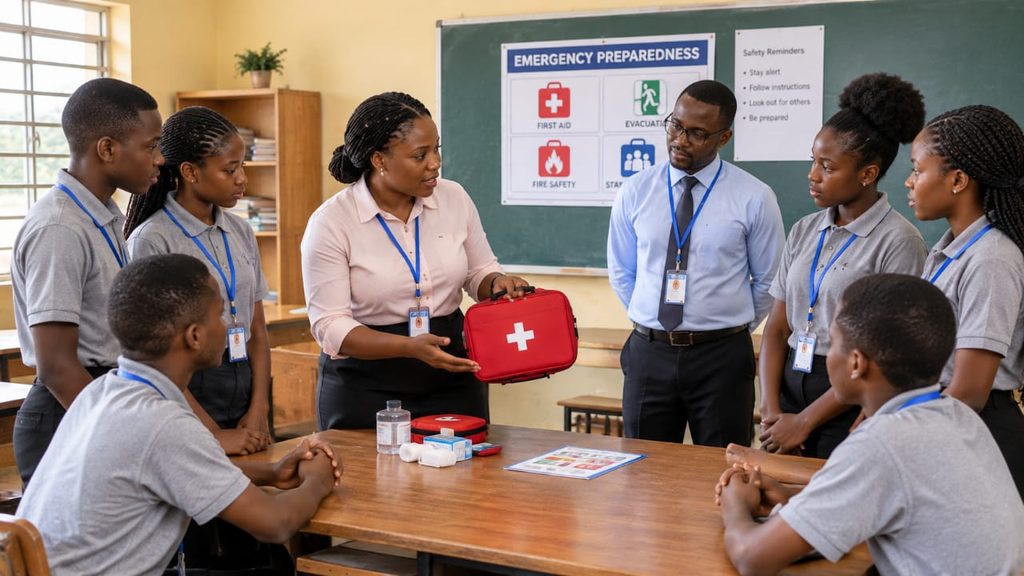
Every school should have a clear first-aid response system, designated responsible personnel and procedures for contacting parents and appropriate medical services when a learner becomes seriously ill or injured.
Ask where the first-aid supplies are kept. Then ask: “Who is trained to respond when a learner is injured?”
Parents should understand:
- Where basic first-aid supplies are located.
- Who administers first aid.
- How serious injuries are escalated.
- How parents are contacted.
- How emergency transportation is handled.
- How learner medical information is managed appropriately.
The objective is not to turn a school into a hospital. It is to ensure that a foreseeable incident does not become more serious because nobody knows what to do.
Does school transportation form part of campus safety?
Yes. School safety extends beyond the classroom to transportation, requiring responsible supervision, vehicle safety procedures, driver accountability and systems for knowing where learners are during transit.
For schools that operate buses, parents should ask:
- Who supervises learners during transportation?
- Are drivers properly vetted?
- Are vehicles maintained?
- How does the school account for children entering and leaving buses?
- What happens if a vehicle breaks down?
- How does the school communicate delays or emergencies?
The Federal Ministry of Education’s Early Warning Handbook specifically identifies school-bus tracking systems among measures that can strengthen transportation security.
Why should parents ask about community partnerships?
Schools cannot manage every external risk alone; strong relationships with families, community leaders and relevant emergency and security agencies can strengthen early warning, communication and coordinated response.
A school does not operate on an island. Its surrounding community forms part of its safety environment.
Nigeria’s safe-school framework promotes collaboration among government, schools and communities, while UNICEF-supported School-Based Management Committees have been used to strengthen community participation in school safety and emergency preparedness.
Parents can therefore ask: “How does this school work with its surrounding community when there is a safety concern?”
The answer can reveal a great deal about how seriously the school approaches preparedness.
What role does technology play in modern school safety?
Technology can strengthen school safety through controlled access, CCTV, emergency alerts and communication systems, but technology should support trained people and sound procedures rather than replace them.
Depending on the school’s size and resources, parents may encounter:
- CCTV surveillance
- Access-control systems
- Emergency communication platforms
- Panic alarms
- Digital visitor records
- Bus-tracking systems
- Public-address systems
The Federal Ministry of Education’s 2025 Early Warning Handbook includes CCTV cameras, panic alarms and school-bus tracking among possible preventive measures. But parents should avoid equating more cameras with more safety. A camera that nobody monitors does not replace responsible supervision.
Technology works best when it forms part of a wider safety system.
How should schools prepare learners for emergencies without creating fear?
Schools should teach age-appropriate emergency procedures calmly and repeatedly, helping learners understand how to respond responsibly without turning safety education into a culture of fear. Children need to know what to do without living in constant anxiety about what might happen.
Schools can teach emergency preparedness through:
- Age-appropriate drills
- Simple instructions
- Safety assemblies
- First-aid awareness
- Fire drills
- Safeguarding education
- Peace and conflict-resolution activities
- Clear emergency signals
UNICEF-supported schools have used drills, emergency signals and safety training to help teachers and learners respond calmly during emergencies. This is where Character Formation becomes relevant.
A safe learner is not simply a frightened learner who follows instructions. A well-prepared learner develops calmness, responsibility, awareness and the ability to respond appropriately. Those are also leadership qualities.
What should parents do after completing the school safety inspection?
Parents should record what they observe, ask follow-up questions, identify gaps and consider whether the school demonstrates a consistent culture of safety rather than relying on impressive facilities alone.
Use this simple scoring-free checklist during a school visit:
Parent’s 10-Point School Safety Checklist
☐ 1. Secure perimeter — Are boundaries and gates appropriately controlled?
☐ 2. Visitor management — Does the school know who enters and leaves?
☐ 3. Emergency plan — Can staff explain what happens during a serious incident?
☐ 4. Fire preparedness — Are extinguishers, exits and assembly points available?
☐ 5. Safeguarding — Is there a clear process for reporting child-protection concerns?
☐ 6. First aid — Who responds when a learner is injured or becomes seriously ill?
☐ 7. Communication — How does the school contact parents during emergencies?
☐ 8. Staff readiness — Do staff receive relevant safety and safeguarding training?
☐ 9. Transportation — If buses operate, how are learners and vehicles monitored?
☐ 10. Community coordination — Does the school work with relevant community and emergency stakeholders?
Do not simply count how many boxes you can tick. Ask what happens in practice. A school may have an impressive list of policies while lacking the training, resources or leadership needed to implement them.
How does school safety contribute to nation building?
A safe school protects more than buildings; it protects the continuity of learning and creates an environment where children can develop the knowledge, character and leadership capacity needed to contribute to society.
Education is one of the foundations of nation building. When a learner cannot attend school because the environment is unsafe, the consequences extend beyond one missed lesson.
Safety protects continuity, confidence, and opportunity. Safety protects the human development that education is designed to achieve.
This connects naturally with the philosophy of Patris Schools.
The goal of education is not simply to produce academically capable learners. It is to develop people of Character Formation, Leadership Education and responsibility who can become constructive contributors to their communities.
The vision of Building Nation Builders begins with creating learning environments where children can safely grow into that responsibility.
The work associated with Dr. Dotun Reju and the wider Patris educational vision places education within this broader framework: learning should shape not only what young people know, but who they become and how they contribute.
A safe school is therefore not merely a protected building, it is an environment in which human potential can develop.
Conclusion: What is the most important safety question parents should ask a school
Ask the school, “If something serious happens today, what exactly will you do?” The quality of the answer often reveals more about preparedness than the number of security facilities you can see.
Parents should not feel uncomfortable asking difficult questions.
- Ask.
- Observe.
- Listen.
- Look for evidence.
- And pay attention to whether school leadership treats safety as a permanent responsibility or merely a response to the latest concern.
For parents considering schools in Plateau State, the standard should be clear: Children deserve learning environments where safety, safeguarding, preparedness and education work together.
At Patris Schools, that principle belongs within the larger work of developing Kingdom Citizens and Nation Builders—learners whose education combines knowledge with character, leadership and responsibility.
Because the safest school is not simply the one with the highest wall. It is the one where people, systems, leadership and community work together to protect learning.